Wednesday, September 6, 2017

Insurance For Natural Disasters: Floods, Fires, Hurricanes, Earthquakes Oh My

Insurance For Natural Disasters: Floods, Hurricanes, Fires, Earthquakes Oh MyBefore I sold my house in the Marina district of San Francisco, I always had a slight worry whether it would survive the next big earthquake. The Marina district, although a highly desirable neighborhood in the north end of San Francisco, is mostly liquefaction – a mixture of sand and dirt that was reclaimed from the ocean.

The last big earthquake was the Loma Prieta earthquake on October 17, 1989 which killed 63 people, collapsed a section of the Bay Bridge, and caused several buildings to burn down in the Marina due to ruptured gas pipelines.

Each time I got the mandatory earthquake insurance offer in the mail, I passed because the deductible (10% – 15% of value of home) was so high and the premium ($5,000+/year) so expensive. I’d ignore the risk I was taking until I’d get the same offer in the mail the next year. I figured worst case, if it burned to the ground, I’d have to spend $650,000 rebuilding a 2,300 sqft structure.

Now that I don’t own a home surrounded by liquefaction, I do feel a sense of relief that I “escaped” almost 13 years of ownership without experiencing a natural disaster. So many people who didn’t live in San Francisco constantly reminded me about the risks of earthquakes before I bought. Then after I bought, so many more people from San Francisco who didn’t/couldn’t buy a home tried to instill fear in me.

What gives folks? Can’t you just be happy for someone’s largest purchase?

As a result of all this feedback, one of my biggest worries was having an earthquake hit while I was in the processing of selling my home. Selling a home is much more stressful than buying a home. If you don’t buy a home, there is no loss except for dashed dreams. If your home falls out of contract when selling, vultures will start circling.

With new devastations seeming to happen around the country every year, I’ve begun to wonder whether it would be wise to look into flood and earthquake insurance again to cover my remaining properties. My homeowner insurance policy cover fire damage, and so should yours.

Natural Disasters Don’t Just Affect Homes

What I didn’t realize was how much damage storms such as Hurricane Harvey can do to cars. It’s estimated that Harvey ruined 500,000 cars by flooding their engines. Similarly, Hurricane Sandy destroyed about 250,000 vehicles and Hurricane Katrina claimed about 200,000 according to Jonathan Smoke, chief economist at Cox Automotive.

Therefore, it behooves everyone to ping their auto insurance companies today and ask what type of coverage they are getting for their premiums. I bet most people have no idea exactly what they are getting for the insurance they are paying. I called my auto insurance company and was reminded I have comprehensive insurance on my new family car with a $500 deductible. I thought I was paying for a $1,000 deductible.

Comprehensive insurance should cover your car from flood damage, hail, a tree falling on your hood, and everything else you can think of. You’ll usually be reimbursed for your ride’s actual cash value (ACV) after you pay your comprehensive deductible.

What’s shocking is that only about 20% of the 1.6 million homes in Harris County, where Houston is located, had flood insurance, according to emailed data from the Insurance Information Institute. For those homes in “high-risk” areas, only 28% of the homes had flood insurance.

Please think about this scenario for a moment. If you have a mortgage to pay, a car to replace, and a home to rebuild out of pocket, there could be no way out of this type of financial disaster except for bankruptcy. 

Besides private insurance companies, the federal government offers flood insurance coverage through the National Flood Insurance Program at an average cost of about $700 per year. Of course, the premiums vary depending on your property’s flood risk and value of the house.

For low-risk homes with the maximum coverage of $250,000 for the dwelling and $100,000 for possessions, the premiums are $405 per year, or $452 if you have a basement. For those who have homes of higher value, it looks like private insurance companies are your only option.

Here’s a video that really shows how Hurricane Harvey affected one person’s home and cars. The fella successfully saved three BMWs, but could not protect his home from damage. I’m pretty sure after seeing this video, if you live in a high risk area, you’ll be motivated to call your insurance company!

Deciding On Whether To Get Natural Disaster Insurance

Insurance companies stay in business because they collect more in premiums than they pay out in claims. It’s actually a great business if you look at the profit figures of all the major insurance companies. Therefore, as a consumer, you probably don’t want to get more insurance than is required by law because you know it’ll likely never be used. That said, here’s a checklist that may help you determine whether getting flood or earthquake insurance is a good move.

* Do you live in a high-risk area? If you live in a coastal state, Texas, Louisiana, or Hawaii, you are subject to hurricanes. If you live west of the Rockies, in Alaska, New England, or along the Mississippi River, you are subject to earthquakes. If you live right on the coast, in low lying areas, you are subject to floods. Basically, disaster can strike anywhere at anytime.

The worst storms in US history

Graphic showing the top 5 costliest and deadliest U.S. hurricanes. [Photo via Newscom]

I’m not sure anybody can ever believe the weather person again when s/he says this is a “100 year storm.” I could have sworn they said that about Katrina, Sandy, and Harvey, and they all happened within 13 years of each other.

* When was the last time you invested in disaster mitigation? After the 1989 earthquake, homeowners in danger zones were mandated to “earthquake proof” their homes with stronger foundations. All new construction after 1989 also required stricter foundation construction. As a result, buildings are now safer than ever before. Obviously we won’t know how strong our homes are until angry nature comes, but we should believe the more we invest in disaster mitigation, the better we will come out at the other end.

Although my new primary residence is not on liquefaction, I did spend some money reinforcing the structure and applying new bolts to the frame. Our condo association is spending about $100,000 – $130,000 retrofitting our building by 2018 due to a SF law.

* Have you talked to your long time neighbors? One of the first things I did before and after I bought my house was ask my neighbors how the 1989 Loma Prieta 6.9 earthquake affected our block. One 69 year old neighbor who has owned his building since 1975 told me not a lot happened at all. Some dishes fell off the shelves, but that was about it. However, five blocks west of us several houses had to redo their facades due to cracks. The houses that sustained structural damage were situated 15 blocks away as they were built on top of sand.

Toppled Marina building due to 1989 earthquake

Roughly 8 blocks away from my old house in the Marina

* What is the estimate of potential damages? After speaking with my neighbors and doing more research about the 1989 earthquake online, I made a realistic $100,000 damage estimate if a similar 7.0 magnitude earthquake hits. I compared the $100,000 to my earthquake insurance deductible of $150,000 + $5,000 in annual premiums and decided it wasn’t worth it. It’s important each of us assess realistic estimates of what a disaster might cost us out of pocket.

* How big is your emergency savings? The less emergency savings you have, the more you may need insurance. If disaster strikes, you could borrow from your 401K, draw money from a HELOC, or go directly to friends and family.

* How dependent is your retirement on your home? Given our homes are often our largest asset, there’s no doubt many people count on their homes to provide rent-free security once the mortgage is paid off, or rental income if they are a landlord in retirement. Some may even depend on their homes to do a reverse mortgage for income. Whatever the case may be, the higher your home is as a percentage of your net worth, the more you need to consider getting disaster insurance.

* How much equity do you have in your home? This is probably the only situation where having little to no equity is a good thing if disaster strikes. Potential disasters are one of the biggest reasons why people should not pay down their mortgage. If you had the ideal mortgage amount of $1 million, your bank ends up eating the cost if you run away.

If The Natural Disaster Gets Really Bad

The only positive out of a really bad situation is that the Federal Emergency Management Agency (FEMA) might step in to provide grants for emergency repairs and temporary housing. Meanwhile, the Small Business Administration (SBA) may offer up to $200,000 in a low-interest loan for rebuilding.

Rebuilding costs soar during times of emergency, largely due to an upward shift in the demand curve. There will also inevitably be price increases by suppliers of material and services to help mitigate such a surge in demand. Lines for gas at the pump last for hours, while electricity might not come back on for weeks, if not months.

The worst feeling in the world is losing everything and not knowing whether you will ever recover if you don’t have insurance. The second worst feeling during a disaster situation is having insurance, and not knowing whether you will ever collect.

Here’s a video highlighting what type of damage Category 1 – 5 hurricanes can do. Let’s pray Hurricane Irma doesn’t stay a Category 5 when it hits land. For those who are investing in heartland real estate, it’s best to bake in potential natural disaster damages into your returns.

Build Goodwill With Your Insurance Provider

It’s unfortunate to hear so many frustrating stories about insurance companies not paying out a claim when something bad happens. The only thing I can recommend is to go with an insurance carrier that’s been around a long time, has a healthy balance sheet, and use them for multiple financial products to build good will so they decrease the chance of screwing you.

For example, you may want to bundle your auto, property, umbrella policy, and flood insurance together. Your agent will love you, and you will be tiered as a more valuable customer given you’ll be paying higher monthly premiums. As a higher valued customer, they will give you less grief during filing, and will also give you the best rates.

When I filed a $7,500 claim for a lost watch, I spoke to the personal property insurance agent for about 10 minutes, answered seven questions, and got a check for $7,500 three weeks later. They didn’t give me a hard time because they’ve been making lots of money off me for the past 20 years.

More Assets, More To Worry About

With San Francisco temperatures reaching a record breaking 106 degrees, a massive fire spreading in Burbank, California, and Hurricane Harvey slamming Texas, Hurricane Irma on its way, there’s something to be said about having only one car and one house. The ongoing maintenance and insurance costs really start putting a damper on your sense of freedom.

If you’re in an area prone to disaster, at least call up your insurance company and look into the costs and coverage. Compare the insurance premiums to the cost of a total rebuild and make a calculated guess decision. There is no such thing as retroactive insurance.

Each year that goes by without paying insurance premiums is a win. But after many years of winning, you might want to use your winnings to sleep well for the rest of your life.

Related:

How Does An Umbrella Policy Work?

A Preliminary Guide To Auto Insurance

The Ideal Amount Of Homeowners Insurance To Protect Your Family

Readers, do you have flood or earthquake insurance? If so, what is your coverage and monthly premiums? Has your home or car ever gone through a natural disaster? What was the cost to rebuild/replace? 

The post Insurance For Natural Disasters: Floods, Fires, Hurricanes, Earthquakes Oh My appeared first on Financial Samurai.


from Financial Samurai https://www.financialsamurai.com/insurance-natural-disasters-floods-fires-hurricanes-earthquakes/

Don't Believe These Popular Credit Myths!

MoneyTips

Many Americans believe credit myths. MoneyTips would like to debunk them.

In a June survey, we asked 410 Americans to rate as True or False some statements about credit. We threw in a few softballs. But when it came to four important credit statements, less than 6% answered them all correctly. In fact, more people got them all wrong (7.1%) than all correct (5.9%)!

If you like, you can quiz yourself about these important credit concepts, and then look below for the answers.

TRUE OR FALSE: You do not need to carry a credit card balance in order to build your credit rating.
TRUE OR FALSE: When a married couple tries to get a mortgage, their joint credit score is used.
TRUE OR FALSE: If I look at my credit score too often, it actually lowers my score.
TRUE OR FALSE: You can improve your credit score by closing unused credit cards.

Ready for the answers?


Believe it or not, all of these statements are false...


from MoneyTips https://www.moneytips.com/do-not-believe-these-popular-credit-myths/950

Tuesday, September 5, 2017

Browse Through Our Free Financial Library

MoneyTips

Have you ever seen ads for "Get Rich Quick" books? We suspect the only person getting rich quickly is the author selling his book! Perhaps the first page of the book reads, "The secret to quick riches is to publish and sell a book on getting rich quick."

At MoneyTips, all of our eBooks filled with financial tips are free to our members. Here are all of our eBooks in one place for your convenience. Browse our library of free financial resources and download the books you want by clicking on the links. You will be asked to join the site, which is also free. What do you have to lose besides bad financial habits?


9 Simple Ways To Raise Your Credit Score

Are you living debt-free and not worried about your credit score? That's fine for now, but what about the future? There will probably come a time when you want to borrow money and having good credit will be vital. Download

Monday, September 4, 2017

Adopting From Foster Care: Clarifying The Fears And Misconceptions

Adopting from foster care is much neededOne of the biggest benefits of financial freedom is the ability to spend more time helping other people. Although writing about building wealth is useful and donating money is good, adopting or fostering a child reaches a next level of kindness. 

Today’s post is from Jillian at Montana Money Adventures. She has adopted not one, but four foster children. People like Jillian are an inspiration. I hope her story helps you better understand the foster care system. I was going to write a post about what I learned at a foster care training seminar I attended, but Jillian’s post is so much better. 

On my very first date with my husband, I mustered the courage to ask him the one question that would be a deal breaker. “How do you feel about adoption?” His answer was encouraging, so I took a deep breath and asked one more question, “How would you feel about adopting from foster care?”

It might not seem like first date kind of conversation, but I’ve never been one to waste time. I was passionate about being a family for kids who desperately needed one, and any future spouse needed to share that passion. Three years later we adopted our oldest son, a teenager from foster care.

The need for foster/adoptive parents is enormous. There are currently over 100,000 children in foster care available for adoption and waiting for a family to step forward. Over 20,000 of those kids will “age-out” of foster care each year, never finding a forever family, and will go into adulthood alone. They are often ill prepared and lacking the support needed to flourish as adults.

The need for foster care adoption is growing rapidly due to increased methamphetamine use across the US. 10 years ago, most kids removed from their biological families were school aged kids. It was in school that teachers would notice the abuse and neglect. Now more babies are born addicted to meth.

The threshold for removing a child is extremely demanding (unlike 20-30 years ago), but meth addicted babies aren’t able to go home with their birth parents. Because meth is extremely addictive, and drug rehab resources scarce, many of those parents don’t sober up in order to be the parents their children need.

Over the last twelve years we have adopted twice from foster care. Our oldest son, Micah, we adopted when he was twelve. Then two years ago we adopted a sibling group of three kiddos. The two groups of kids who struggle the most to find families are older kids and sibling groups. Those are the kids that pulled on my heart the most. The kids that everyone had passed over, and might not get another chance for an awesome family. (I will use the term “family” but that doesn’t mean a married wife and husband. Any adult willing to come alongside these kids is “family,” and the states won’t discriminate based on age, marital status, gender, race, religion, or sexual orientation. And “awesome” doesn’t mean perfect!)

There are some common misconceptions when it comes to adopting from foster care. After adopting four kids from the foster care system, speaking to foster-adoptive groups, and my husband’s former work of licensing adoptive families for hard to adopt kids, these are the most frequent concerns we have heard.

5 Common Concerns About Adopting From Foster Care

1. The kids in foster care are criminals or bad kids.

There are over 400,000 kids in foster care currently. They aren’t criminals or bad kids. They are in foster care at absolutely no fault of their own. Their biological parents just can’t care for them right now. These kids have experienced horrible trauma, abuse, neglect or drug addiction. Then they were removed from their home, which from an adult perspective is a good thing, but it’s a horrible loss for the child. They just lost everything they know. Their parents, their bedroom, all their toys, their friends, maybe their school. They might have been separated from siblings when the social worker couldn’t find a foster family who could take all the kids together. Those things might not have been great, but it was their whole life. They are hurting. They don’t have the words, comprehension, or ability to express all that hurt. They don’t fully understand how to process the trauma they have seen and lived through.

They try to cope the best they can. And often it comes out sideways. Instead of asking for a conversation and hug, they might throw things and yell. Instead of talking about how they are worried about their biological siblings (because it was the 7-year-old who always took care of mom when she was high) they might throw a tantrum.

But it’s one of the most beautiful parts of being a foster and adoptive parent. Slowly, bit by bit, they change. Right before your eyes. As we love them through the behaviors, as we pull them close, as we help them wrap words around the hurt and confusion they feel, they become their true selves. In small moments you see how sweet they are. You discover that they are actually crazy smart and awesome at school. They are funny and witty. They become people who are passionate and sympathetic for others. It’s the hurt, trauma, and loss we see at first. But if we stick with them, and love them through the hurts, we get to see the transformation. Of all the parts of our story, adoption is the most amazing and rewarding thing I’ve been privileged to be a part of.

Do you want a perfect child for your family?

Or can you be an awesome family for a child?

There are about 1000 miles between those two question.

The child you foster/adopt won’t be perfect. They are dealing with a lot. But if you can be an awesome family for a hurting child, that is what they most desperately need (reminder, “awesome” does not mean perfect). A great family could change everything for them. Their entire life trajectory can shift.

2. It’s expensive.

Private adoption is expensive and overseas adoption is expensive ($20,000-$40,000). Whereas, adopting from foster care has very little, if any, upfront cost. You might wait in line for years to get a baby from a private agency. Whereas, the kids in foster care have waited years for you. Because 100,000+ are waiting, and very few people are getting in line for them, the US government has tried to remove as many of the financial barriers as possible to help these kids find forever families.

Typically the government will cover the cost for your home study, training, and adoption filing costs. If your child has ongoing needs, your state might help with that even after you adopt. There are special tax credits for adopting kids the state deems special needs (that could be a child of certain races, sibling groups, those with disabilities, or older children). If you adopt older kids (over 16) they qualify to receive the full FAFSA amount for college despite your income.

The cost to adding a child(ren) to your family is still high. Primarily in terms of time. All kids take time. These kids might need a little extra time. Knowing that I wanted to adopt was a large motivation for striving to create more financial freedom. We have been able to take our 4th and longest mini-retirement while our kids needed us most. Over the last 15 years, we have built up enough passive income to cover all our expenses. It’s enabled us to really lean into what is best for our family in each season and only take on work that fits our families lifestyle. FIRE absolutely isn’t a requirement to adopt, but it’s been a huge help for us while adding a high needs sibling group to our family.

We had very low upfront costs with our adoptions. I would say overall the costs are similar to having biological children. We did buy a minivan ($10,000) and extra furniture ($3000). I left a full-time job ($30-40k a year) for two years before this mini-retirement to be a stay at home mom. Our kids came with 12 appointments a week for the first year!

We also do more planning for the long term costs our kids might have. I have no expectation of them being 100% fully independent and self-sustaining at 18. Very few kids these days are, and that might be even more the case with our kids.

Jillian and her family

3. The kids might be returned to their biological parents

There are two ways you can adopt from foster care. 1) You can welcome kids into your home whose parents are currently working a reunification plan.

Those parents are trying to make the needed steps to get their kids back. If those biological parents are able to be reunited with their kids, that is the priority. If not, your state would look at other biological family members who could care for them.

Out of the 400,000 currently in care, 300,000 fit in this group. If those first two options aren’t possible, the state would most likely ask the foster parents to adopt the child. That is how we adopted our sibling group of three. Because of their needs and behaviors we were their 4th foster family, which added to their delays and challenging behaviors. The Child Protection Services would prefer just one foster family from start to finish, but that is rarely the case. We were there foster parents for 1.5 years before we were able to move forward on the adoption.

In the past, this could be a very long journey, sometimes lasting 5-10 years. The government finally wised up and acknowledged that isn’t healthy for kids to live in limbo for that long, not knowing where they belong. Now the federal mandate is 18 months. Birth parents have 18 months to work a reunification plan before the courts move towards terminating parental rights. It doesn’t always go quite that way, but it’s closer to that timeframe now than in years past.

Or option 2) The other 100,000 kids who are just waiting. Their birth parents rights have been terminated and they are free for adoption. No other biological family was a healthy fit. Now they wait. And hope. For someone to step up and take a chance on them.

You can see profiles of many of the waiting kids on Adopt US kids plus all the information to get started as foster/adoptive parents. It’s often easiest to adopt kids from your own state, but you are legally able to adopt kids from anywhere in the country. This is how we adopted our oldest son. He was already available for adoption. We lived in Virginia and he was from Nebraska. The federal government mandates a six month trial period, where we were his foster parents, to make sure it’s a good fit for everyone. After that, we were able to officially adopt him.

Adopting from foster care

4. There is a waitlist like with private adoption.

The need for foster-adoptive parents is overwhelming. Unlike private organizations, the states aren’t allowed to discriminate based on religion, gender, marital status, orientation, etc. They are just looking for awesome people. It doesn’t matter if you’re single, gay, young or old (although you have to be an adult, over 21 in most states).

The process is invasive and long. The first step is to contact your local child protection agency and get signed up for classes. After you finish the classes you will go through background checks, overly personal questionnaires, a million rules, and constant delays. The need is great, but they want to make sure you are qualified/prepared to be an awesome family.

It also takes far longer than it seems it should. Between your first phone call and a child arriving at your home, it could be anywhere from 6-18 months.

The foster care system is overwhelmed right now and funding is always tight in social service agencies. If you are adopting in order to have an amazing experience in the approval process, well, that won’t happen. You will meet some of the most amazing people on Earth. Dedicated, hard working, passionate social workers who have given their life for this cause. But they won’t have time to return a phone call. Just FYI.

5. It will end badly and it’s not worth the risk.

I once heard that 30-50% of people consider adopting at some point. In reality, only 2-4% of Americans ever do. I think the gap might be due to not really understanding the process/options/ or how to start.

And fear. Mostly fear.

What if it all goes wrong? What if I’m not up to the task? What if the kid is horrible or dangerous or ruins our family? What if they don’t love me? What if I don’t love them? What if they go back to their biological family and my heart breaks so much that I never recover?

We fear the worst and are paralyzed by it. There is risk. But there is always risk in anything worth doing.

My best advice: Do your research, ask good questions, stay open minded, and just start the process. Calling your local Child Protection Service office isn’t a forever commitment. Signing up for the classes isn’t a forever commitment. Looking at the kids on Adopt US kids doesn’t mean they are moving in tomorrow. It’s a long process. So if you really are interested and feel like you could be a family to a child, just start.

And if everything goes wrong…you can’t waste good.

Micah

Our first adoption had the worst ending that I could imagine. At 20 years old, our oldest son died. He was Type 1 diabetic when we adopted him. Diabetes, along with his behavior, educational delays, and emotional problems were the reasons he struggled to find a family. Eight years later that disease took his life due to a case of mild food poisoning.

After eight years of being Micah’s mom, I had to bury my child. I had to write his obituary and pick out songs for his funeral. It was the worst possible ending to our story. The grief and sorrow nearly crushed me.

But you know what? I wouldn’t trade those years for anything. For eight years I got to be Micah’s mom.

Through all his struggle and challenges, I got to watch him grow into a strong, compassionate young man. He was better for having been part of our family, and I was definitely better for being his mom. I grew just as much as he did during those years. And his story changed those around him. That time and that work mattered. Even though I would never wish that pain on anyone, all the good and love we poured into him wasn’t wasted.

No matter how your story works out, all the love you put into these kids, it won’t be wasted. You can’t waste good. In the things that matter the most to us, there is always fear. There are always unknowns.

Our adoptive kids are adorable. They are sweet and kind and simply amazing. People comment all the time about how wonderful they are and how they would love to “take them home.” Part of me wants to say, “There are about 100,000 kids just waiting for you.”

Once you know the kids who are waiting, who need a home, it changes everything. They aren’t a number, but a real person that you would do anything for. I would cross oceans for my kids. I’ll go to battle to defend and protect them. There is always risk, but my kids are worth the risk. So are the 100,000 kids waiting and the 300,000 in limbo in foster care.

Additional Foster Care Resources:

This was the short movie I (Sam) watched in the training seminar which made me realize a foster child may not want to leave his/her parents at all, despite a bad situation. I also learned that despite one’s good intentions, there may be triggers unbeknown to you that may set off a child.

Additional information on adopting (Childwelfare.gov PDF)

College options for older adopted children (Nacac.org)

Meet the kids waiting for families (AdoptUsKids.org)

Jillian writes about creating a life with more financial freedom, adventure, and mini-retirements over at Montana Money Adventures. The rest of the time she is hiking in Glacier National Park, chasing 5 kids, gardening and drinking imported black tea.

After attending a three-hour training seminar at Braid Mission in SF, Sam will be joining a team to mentor a foster child once a week this winter. It’s his small way of getting more involved in a world where much help is needed. Perhaps you’d like to join him if you are located in the Bay Area.

The post Adopting From Foster Care: Clarifying The Fears And Misconceptions appeared first on Financial Samurai.


from Financial Samurai https://www.financialsamurai.com/adopting-foster-care-clarifying-the-fears-misconceptions/

Tuesday, August 29, 2017

Today's Headlines: How Does the Debt Ceiling Affect You?

MoneyTips


Yet Another Crisis

Every day in Washington, D.C., seems to bring new crises to defuse. One of the next ones on the list is the upcoming need to raise the debt ceiling before the government runs out of money to pay the nation's bills. Without action, the government is anticipated to run out of money in early October.

Once again, one group is asking for clean legislation to raise the debt ceiling, while others threaten to use the debt ceiling bill as leverage to promote other legislative goals. The novel twist this time is that Republicans are fighting other Republicans.

At first glance, this may seem like more partisan Washington nonsense that doesn't affect you personally. The partisan and nonsense part may be correct, depending on your political leanings – but the effects of a failure to raise the debt ceiling can lead all the way to your pocketbook.


Who Gets Left Out?

Keep in mind that raising the debt ceiling does not a...


from MoneyTips https://www.moneytips.com/todays-headlines-how-does-the-debt-ceiling-affect-you/857

Monday, August 28, 2017

Why I Sold My Rental Home: Had To Live For Today

Why I sold my rental property after 12.5 years.After hearing direct feedback from about 80 of you through social media, my private newsletter, various post comments, and a poll with over 1,500 votes, I decided to sell my Marina, San Francisco rental house I bought in early 2005. I lived in the house from age 28 -37 and had some wonderful memories there. But after three years of being a landlord, it was time to move on.

The decision was incredibly agonizing because I believe it’s best to hold onto a property forever. When I finally sold the house, I didn’t feel joy, but disappointment. I sat in the lounge area of a bank branch looking at the largest check I’ve ever seen in my life and feeling like I had failed my son, myself, and all of you. I’m long-term bullish on San Francisco property, but I felt I had to start living for today.

20 years from now when my son asks how I could have sold the house for so cheap, I’ll point him to this post as I’ll have long forgotten all the details by then. Hope you can forgive me dear boy.

Why I Decided To Sell My Rental Home

Sell or keep rental home poll

77% of you said sell

Back when I was 27, I decided I no longer wanted to live in a two bedroom condo even though it was perfectly fine. Unfortunately, average single family homes in the northern part of San Francisco cost about $1.8M or more back in 2004. But one rainy December afternoon, while I was parking to look at a $1.2M three bedroom condo for sale, I stumbled across a handsome single family home that nobody seemed to want.

The listing agent was from out of town and all she had was a messy home and a flimsy one page black and white flier. To contrast, most homes in this price range have multi-page colored brochures. The house had been sitting on the market for two months and she told me if she didn’t get an offer by Christmas, she was taking the house off the market and re-listing it in the Spring.

Knowing that selling during the holidays is a sign of desperation, I sat down with her to learn more about the seller’s story. The seller was a newly retired couple that hailed from Texas. They had wanted to relocate to San Francisco, but after a knee operation, the wife decided she didn’t want to live in a house with two flights of stairs. As a result, they never moved in and kept renting back the house to the previous sellers. Then I came along.

The listing price was a “more reasonable” $1.55M. It truly was since other homes of similar or smaller size sold for $250,000+ more. Besides not being marketed properly and the incessant winter rain, the main reason why the house wasn’t selling was due to its location on a busy street next to one of the busiest streets in all of San Francisco. We had our concerns too, so we parked outside the house multiple times for 30 minutes each session to see if we could stand the road noise.

The overall market in SF was still strong for properties under $1.5M in 2004. But I discovered that as soon as I crossed the $1.5M threshold, demand fell precipitously. Here was an open market opportunity to buy a single family home below asking, instead of constantly get outbid. I decided that with the installation of double pane windows, the road noise would be bearable. I proceeded to make an offer $25,000 below asking in December 2004.

When they accepted, I felt instant dread. Should I have offered $1.45M instead? But deep down, I felt the house could easily be worth $2M within 10 years, so I went ahead and dumped my life savings into the house and got a two month bridge loan from my grandfather for part of the 20% down payment. My year end bonus got paid out every February.

After purchase, the house continued to appreciate for two and a half years, but the financial crisis came and knocked its value right back down to where I had purchased it, if not $100,000 less. With a $1.2M mortgage, I wasn’t feeling that good about my financial future anymore.

A Recovery And Another Chance

After almost losing my shirt during the financial crisis, the market finally stabilized and miraculously, after more than seven lay off rounds, I still had my job. I remember telling myself that if the housing market ever rebounded where I could eek out a profit, I would sell and never take on such massive debt again.

So in 2012 right when Facebook went public, I decided to list the house, thinking surely someone would be interested in buying a 3 bedroom, 2.5 bathroom home with an unwarranted room and bathroom on the ground floor. The listing time also coincided with me leaving Corporate America and losing a healthy salary. The mortgage was still about $1,000,000 and I worried whether I had made the right move to leave a job so young. During a time of transition, having more liquidity seemed prudent.

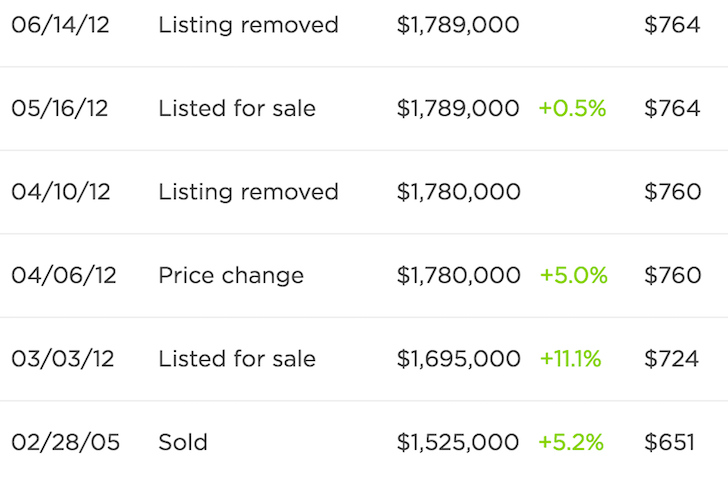
After one month of no interest, I decided to do something cheeky and raise the asking price from $1,695,000 to $1,780,000 and then to $1,789,000 (see picture). My ego was bruised and I wanted to show strength. But after another 28 days with no interest, I decided to remove the listing. Destiny wasn’t cooperating with my plans to sell, so I didn’t force the issue. Instead, I refinanced my mortgage to save ~$400+/month and focused on traveling around the world and growing Financial Samurai.

Nobody wanted to buy my house in 2012, thank goodness.

The Transition To Something New

In 2014, we bought a fixer on the western side of SF because we wanted to experience a new adventure in a different part of town. We were *this* close to relocating to Honolulu, but decided if we could bring Honolulu to San Francisco in the form of a house with ocean views, we’d stay for several more years.

Financial Samurai Deck Remodeling

Finished building a deck in my new house in 2016

Instead of trying to sell the Marina house again, this time we decided to rent it. To our surprise, we found tenants willing to pay $8,500 a month in rent, so we accepted. The four guys and a dog ended up being a PITA to manage, but $8,500 was way higher than we thought we’d get so the aggravation seemed worth it.

This initial set of tenants only stayed for one year. My next set of tenants were five guys who were willing to pay $8,800. They were the best candidates I could find at the time, largely because families with small children were worried about being so close to a busy street. Either that, or they simply bought. I accepted a $17,000 rental deposit and prayed everything would be OK. For the most part, everything was OK. But there was constant roommate turnover, late rent payments, and maintenance issues (leaky roof, broken kitchen faucet, broken fridge, holes in walls, cracked tiles, damaged kitchen doors, noise complaints, and lawn neglect) that finally made me cry uncle.

Related: Being A Landlord Tests My Faith In Humanity

In addition to dealing with all these issues, I was also busy project managing my new home remodel. Remodeling an entire home is already stressful. Add on rowdy tenants and life begins to become unbearable, even if you don’t have a job to go to. Thank goodness we have been able to resolve these stresses and focus on the birth and care of our new son. As prospective parents, we didn’t know what to expect, but we did know from lots of feedback that raising a baby is way harder than what people say (so true). We wanted to free up as much time as possible to prepare for this new chapter in our lives.

Renting out the Marina house for three years wasn’t a great experience, but at least I gave it a go. The ~$60,000 in net rental income enabled me to finally achieve my long term passive income target of $200,000 a year. But like Anthony Scaramucci, who was fired just 10 days after being named White House communications director, my $200,000 a year in passive income didn’t last very long.

I held onto the Marina house in 2014 because it was tough to let something go after so many good memories. I also didn’t want to be embarrassed again. Besides, I was bullish on SF real estate. Financially, I had a $400,000, 7-year CD come due that provided for the downpayment of my new home. Further, my online business continued to grow.

But after vacating it for almost three years, I no longer had a strong attachment to the Marina house because by then we had made amazing new memories in our new house in Golden Gate Heights. When you remodel every inch of the house, you naturally get more attached to it. I also remember the first night we brought our son home at midnight. It was a magical moment.

Property Prices Rise

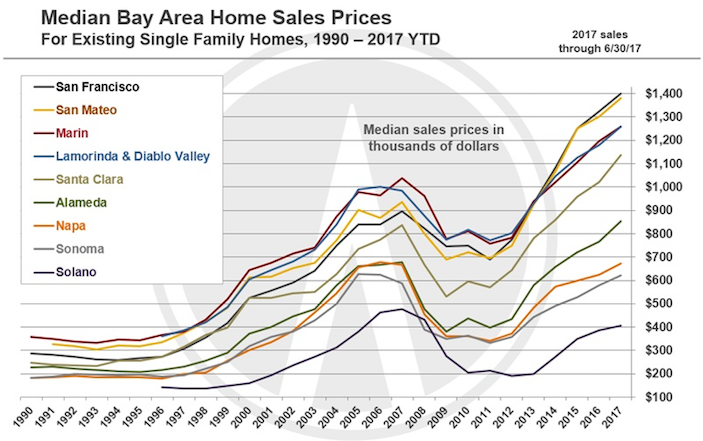
SF Bay Area 2017 Home Prices Historical Chart

SF median home price rises above $1.4M in 2017, way above the 2006-2007 peak

From a financial point of view, we got very lucky. Because nobody wanted to buy our house in 2012 we’ve been able to double benefit with leverage from a ~20% appreciation in the Marina rental house and a ~35% appreciation in my primary residence.

It’s funny to see how quickly sentiment can change. Most people generally have to sell to buy another house in SF, but I took some risks and leveraged to the hilt. For some time, as the bull market kept on going, I felt stymied by an earlier decision to lock up $300,000+ in a 4.1% yielding 7-year CD . But as it turned out, it was the expiration of the CD and the availability of that money that enabled me to buy my new home.

Further, I had thought there would be a two or three year slowdown in property prices starting in early 4Q2015 when many private companies had their valuations slashed. While the market did slow down for a couple quarters, by the Spring of 2017 it had recovered and was as hot as ever for single family homes. The condo market, on the other hand, is definitely cooling due to a surge in new supply.

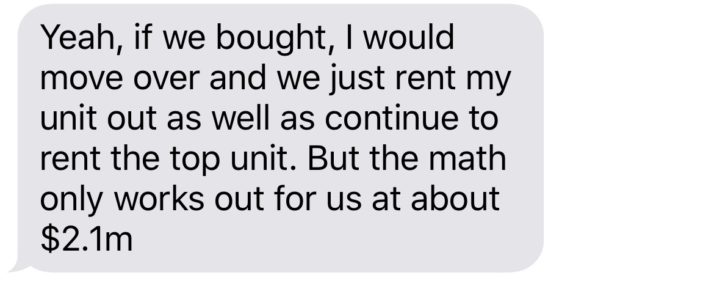
By early 2017, after the 8th time my tenants were late paying rent, I started thinking maybe I could get $2.3M or $2.4M for the house (from $1.7M in 2013). And if I could, I would sell. I was texting back and forth with my neighbor to give him the first look, and he said he’d be interested in buying my home via a private transaction for $2.1M. I passed, even though it would have been nice to save on all those fees. I remember feeling vindicated, however, that finally, my home was worth what I thought it could be worth all these years later.

Text offer from my neighbor

May 2017 offer from my ~35 yo neighbor who has been living for free in his parent’s building since graduation

Then, unexpectedly my tenants gave me an opportunity to test the market by informing me of their intention to vacate on May 8, 2017. I set up a race like I did in 2016 when my condo tenants vacated. In one lane was me in charge of finding suitable tenants within 30 days. In the other lane was a realtor in charge of finding a buyer off market within the same time period for $2,500,000. I decided on $2,500,000 as a stretch price because I was reluctant to sell. Whoever found the client first would win!

Unlike in 2016 with my Pac Heights rental condo, I lost. I couldn’t find my ideal tenant, someone who would take care of my property and stay for at least a couple years. One single mother of four children offered $7,500, but I passed because she was a highly unprofitable startup founder. Another family of 6 offered $7,800 and I passed due to too much wear and tear and such a weak offer. It is much harder to find a $9,000/month renter versus a $4,200/month renter.

Meanwhile my realtor was able to identify a buyer who had lost in a bidding war for a comparable property in my neighborhood. One thing led to another and I received an offer for $2,600,000 just nine days later! It’s worth noting that I had already been looking for tenants for 30 days already before the race began given I received a 30-day move out notification.

Analyzing The Offer

I was astounded by the $2,600,000 offer because another highly experienced realtor had told me that if I put in $50,000 worth of work painting the house, updating the light fixtures, changing the master bathroom tub, and replacing the kitchen floor I *might* be able to get $2,500,000 or so. She was a top producer with 30 years of experienced and visited my house twice to come up with her assessment.

Another realtor I interviewed said that if I put $30,000 into staging, painting and modernizing the light fixtures, I’d probably get around $2,300,000. I was not impressed. But I understand it’s important to manage expectations and surprise on the upside.

I went with my realtor because in 2016 she had sold a neighboring home in Golden Gate Heights for a massive premium. I was impressed with her professionalism when I corresponded with her and most importantly, with her results. The aforementioned house was a dump, had to go through probate, yet finally sold for $150,000 more than I thought (10% over).

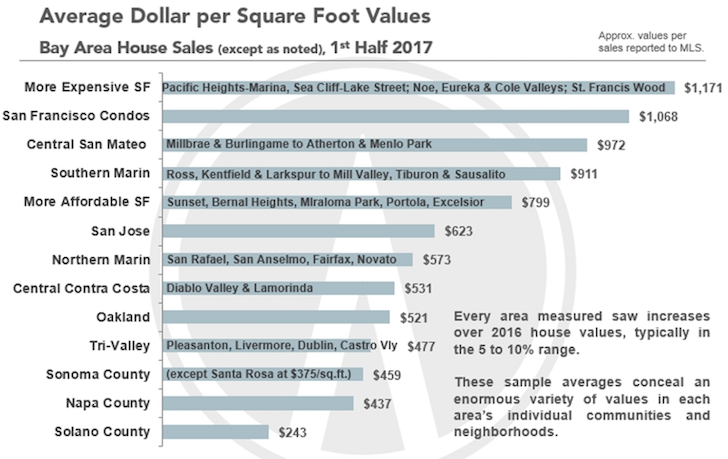
My realtor firmly believed I could get $2,500,000 without having to do any further work since I had already painted a couple rooms and refinished the floors. My house is 2,070 sqft plus about 230 sqft of unwarranted space. If you slap on the average price/sqft of $1,171 in the Marina, you get $2,423,970. But my house should trade at a discount due to the location.

Average dollar per square foot in the SF Bay Area real estate market

The average price/sqft in the Marina neighborhood is $1,171

Even with a surprising offer of $2,600,00, because of commissions, I wasn’t completely convinced I should sell. I was able to negotiate the total selling commission down to 4.5% from 6%, but that was it. In this day and age of the internet, a 4.5% commission is still egregious. That said, the previous realtor who I used in 2012 for a 5.5% fee hadn’t found me a buyer for $1.7M after 28 days. So at least my latest realtor had something for me to consider.

The Counter Offer

We had several other realtors come with their buyers, but nobody made us an offer. The road noise and traffic were always the main deterrents.  For some reason, these buyers didn’t mind the noise and were charmed  the aesthetics of the home.

Given I didn’t need to sell, I decided to counter at $2,788,000 to cover my commissions, transfer tax and then some. Why not try and test the upper limits without losing the buyer? After several days of hemming and hawing, they came up to $2,700,000, saying this was the best they could do because their purchase depended on bank underwriting.

I was tempted to accept because now I was $200,000 – $300,000 higher than what I hoped to get. But, my realtor kept encouraging me to reconsider the price because she knew I was on the fence.

I countered $2,750,000 firm with a lovely letter about how much they would enjoy living in a single family home with a toddler, instead of in a condo. I wrote about all the upgrades we had done over the past 13 years to make the home perfect. I gave them an Excel spreadsheet of all the things we did and the cost of each item to make them feel like they were getting a good deal. I also showed them pictures of all our work.

After another several days past my acceptance deadline, they acquiesced! $2,750,000 is a significant number because it is a full $1,050,000 more than what I would have sold it for just five years earlier. Being able to earn $210,000 a year in equity while also collecting $100,000+ a year in gross rental income the last three years blew my mind.

It felt like I may have won the lottery!

I write “may have” because the buyer wasn’t the commonly cited cash buyer all sellers hope for. Instead, the buyer had to not only take out a $2,000,000 loan, he had to take out another $300,000 loan at a much higher interest rate because he only had about $400K in downpayment.

Three years earlier, he had bought a $1.5 million condo in the same neighborhood before he had a son. Based on his finances, the max the bank would allow him to buy was $2.6M. The sellers admitted they had been hunting for properties in the $2.3M – $2.5M range when they heard about my house.

Why I sold my $100,000 rental home after 13 years

Dining/living room of rental home

Things Started Getting Dicey

When the deadline to remove the financing contingency arrived two weeks after accepting my counter, nothing happened. His bank was making him jump through more hoops so he wanted to keep his financing contingency because if he removed the contingency, and the loan didn’t go through, he’d be out $82,500 (3% earnest money downpayment).

With no other rental offers, I decided to extend the deadline several more days after already extending the inspection contingency deadline by four days. But after five days of not getting any sort of update, I began to worry. Worry turned into frustration, so I decided to aggressively look for more renters again! Each day the deal didn’t go through was another day of lost rental income in my mind.

I kept on telling myself that I would regret selling the home 20 years from now due to the robust job engine here in the SF Bay Area. So after a 15 day respite, I marketed my property hard again to find a group of tenants. After a week, I found a group of five guys (girls don’t exist in San Francisco) who ironically all worked at my old employer! It was destiny!

They all made about $80,000 – $95,000 base salary each as first or second year financial analysts. I thought it would be hilarious to write in a future post that even after getting paid for five years after I left thanks to my negotiated severance, I would still get paid by my old employer for at least another year! It would feel absolutely fantastic, so I decided to go with them.

There was only one problem. Instead of offering the $9,000/month that I wanted, they offered $8,300. I countered with $8,500 and told them they could start one month later on July 1, instead of on June 1. They were originally asking to move in on July 16, but I felt that leaving my property empty for that long while also having an outstanding offer to buy was too much.

They finally agreed on the terms, but they bailed the Saturday morning we planned to meet up! They told me they found another property and thanked me for my time. In other words, the true market rental price for my house was not $8,500, but closer to $8,000 a month or maybe even less given two parties offered even less.

Now it was time to panic again because I had sent a document to my buyer to reject the offer and release him of his $82,500 earnest money deposit. Now I had NOTHING. Using my Buy Utility, Rent Luxury framework, someone was offering me 28.5X – 30X my gross annual rent compared to the 20.5X average for the SF Bay Area and I rejected him! What was I thinking?!

But thankfully, the buyer didn’t know everything that was going on, on my end. After I sent the recision document, they told me they were working as hard as they could with the bank to get the loan finalized, and that they still really wanted to buy my house. They said that by Monday or Tuesday, they should be able to remove the contingency and for me to please wait several more days.

Given I had nothing, and nothing could be done during the weekend, I told my realtor to tell the other realtor that I was OK to wait, but no promises. I wanted to them to feel a tremendous sense of urgency to get their loan done since they were already a couple weeks past the deadline. Meanwhile, I was mentally preparing to just keep my house empty for the next 22 years because I was so sick and tired of dealing with renters.

That’s right, I was willing to pay $22,000 a year in property tax, $2,000 a year in home insurance, $5,000 a year in random maintenance costs totaling over $600,000 after 22 years just to hold onto this asset nobody seemed to want to buy or rent. My pride was speaking again.

All signs pointed towards the deal not happening.

Nail Biter Until The Very End

I was stressed, annoyed, and anxious during this 45 day process. Remember, I was getting very little sleep taking care of a newborn who would wake up very 30 minutes to 2 hours. I was running on adrenaline. Then I was running on fumes. Then the fumes ran out so I decided to settle on leaving the house empty forever.

When the buyers were finally ready to remove the financing contingency, I had to make a decision to tell them to go ahead with writing a new offer or telling them I had moved on. By this time, I was too tired to negotiate any longer because they were also holding me to about $35,000 in immediate weather proofing work that needed to be done after the inspector found leaky windows and dry rot. I had disclosed to them one of the light wells leaked through the dining room during the recent winter storms. They were rightfully concerned, and so was I since all I did was get up on the roof and spray the crap out of the roof with FlexSeal.

In the very end, we agreed to a price of $2,740,000. I gave them a $10,000 discount to address the inspection report so they would finally remove the financing contingency and get on with it. The final price/sqft came out to be $1,323, a 13% premium to the average price/sqft in the most expensive part of the town.

I’m happy for the buyers because their loans went through and they’ve now got a great home to raise their son for the next 10+ years. I just hope his new business venture goes well and the economy continues to chug along.

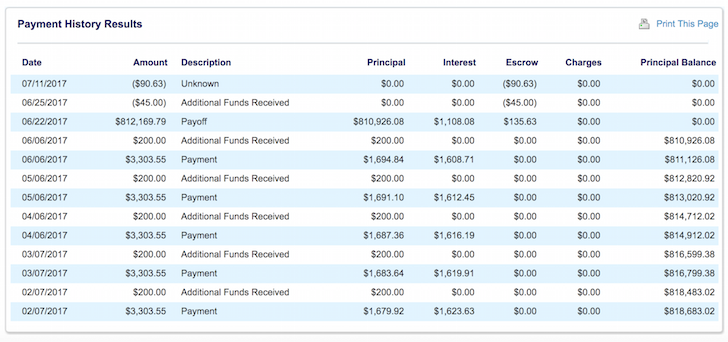
Rental house mortgage payoff

$810,926 of debt was paid off in June

This piece of real estate served us well, and now we no longer have a use for it because we have a new home and more powerful streams of semi-passive income.

In 20 years, I’ll have wished I held onto the property. But I just have to remind myself about all the time and stress I will save by not owning. The older you get, the more valuable time becomes because you have less of it. Besides, I’m just thankful nobody bought the house for $1,050,000 less in 2012.

Dear son, if you got through this beast of post, well done. The bottom line for selling is that I wanted to simplify my life so I could spend as much time with you as possible.

Related:

Every Factor To Consider Before Selling An Investment Property

Debt Optimization Framework For Financial Freedom

Anybody sell their property recently? If so, how did you come to the decision? If you have a harrowing property selling experience, I’d love to hear it! When do you think the real estate market will finally go down?

The post Why I Sold My Rental Home: Had To Live For Today appeared first on Financial Samurai.


from Financial Samurai https://www.financialsamurai.com/why-i-sold-my-rental-home/

Saturday, August 26, 2017

Stop Frugality From Leading To Lifestyle Deflation

Stop frugality from leading to lifestyle deflationLike many of you, I’m frugal to a fault. For 13 years after college, I saved 50% – 70% of my income partially due to humble living conditions. From 28-37 I drove a $8,000 car that depreciated to $3,000 even after my income grew by 3X. And even after I had finally escaped the corporate world in 2012, I still couldn’t stop saving at least 50% of my income.
By the third year of early retirement, however, I started seriously questioning the point of working and saving so much if the money was never going to be spent. Saving for retirement in retirement is illogical. I started getting angry at being unable to kick my frugality addiction to the curb. People with much less were spending so much more and having a great time doing so. Why couldn’t I be more carefree?

Despite my best efforts to spend more like everyone who posts about their fabulous lives on Facebook, touching principal still felt like a crime. Instead of relaxing as a good retiree should do, here’s what I did instead to maintain a 50%+ savings ratio:

* Worked on ways to generate $200,000 a year in passive income

* Took on part-time consulting gigs with three fintech companies over three years

* Continued publishing 3X a week on Financial Samurai

* Developed new online business partnerships

* Downsized to a smaller house to free up cash flow

* Bought a Honda Fit instead of a Jeep Grand Cherokee Limited

* Invested 90% of every dollar saved

Then one day, I burned out. I dropped all my consulting gigs, wrote the biggest e-mail autoresponder known to man saying I was too busy, and finally found some breathing room to spend a little more than normal.

Instead of limiting myself to $100 shoes, I ventured out and bought a $240 pair of shoes (on sale for 50% off of course). The guilty feeling only lasted for an hour while the pair of Tod’s loafers is still my favorite shoe three years later.

Instead of taking an Uber Pool to save $6 to go downtown, I began ordering my own Uber. I still feel guilty for some reason, but the feeling has lessened because I remind myself that time is way more valuable than money.

Instead of staying at a 3-star hotel in Angkor Wat, Cambodia, we decided to stay at a 5-star hotel for $100 more a night. We knew we were never coming back, so we also hired a private van with much needed AC to be our driver for $50 a day. It was so worth it.

Then I realized something. Keeping spending constant after a certain age eventually leads to lifestyle deflation because everything is relative. If everybody still watched cathode ray tube TVs, you’d be happy with your tube TV. But you’re no longer as happy when everybody else is watching a paper thin 4K TV. If you don’t at least increase your spending at the rate of inflation, your quality of life will begin to deteriorate because you can’t help but notice progress all around.

For those of you who can’t seem to lift your spending despite an increase in your income and net worth, let me share with you five ways for overcoming frugality so you can maximize your lifestyle. Dying with way too much is poor consumption planning. 

Halting Lifestyle Deflation In Five Steps

1) Find your marginal spending ratio. Being overly frugal means you either don’t make enough money, fear your income won’t last, or are stuck mentally in a time when you didn’t make much money. There is no denying that having less money means you are forced to spend less. If you suddenly started making an extra $10 million a year, you bet your bottom dollar that you’d be able to spend more freely. Therefore, the easiest way to crush frugality is to make exponentially more money. By doing so, you can’t help but spend more.

The key to unlocking additional spending is determining how much extra money you need to make in order to spend an extra $1. Some consumers will spend an extra $1 when they only make 50 cents more. Others might require earning $10 to spend an extra $1. Earn enough to find your ratio for various things.

For example, I need to earn at least $500,000 more a year to feel comfortable spending $8,000 more on a first class ticket to Europe or Asia. Until then, I’ll sit in the middle seat near the toilet for 12 hours because $8,000 / 12 = $667/hour!

Related: When Do You Finally Feel Rich

2) Make your income more defensible. If your income and wealth are tied to the survival of a startup that has only 12 months left until it runs out of cash, there’s no way you’ll ever break free from frugality. Conversely, if you work in a massive corporation that never fires anybody and provides everyone a nice pension after 20+ years of service, you should be able to open up the wallet a little wider.

Nowadays, the best way to create a more defensible income is to build multiple income streams – including both passive and active incomes. If you can get to a passive income level that covers all your expenses while also having a day job income, you should be able to crush your frugal habits.

Achieving $200,000 passive income figure was a relief after 16 years of trying. It is more than my wife and I spend each year. When we added on corporate consulting income on top of online income, we finally stopped checking the price of food before ordering at a restaurant. We also didn’t care about the latest cost of an electronic gadget anymore because it was a business expense. We knew that worst case, even if our business went to hell, we’d have passive income made up of 10+ different sources that would carry us through on top of our principal. 

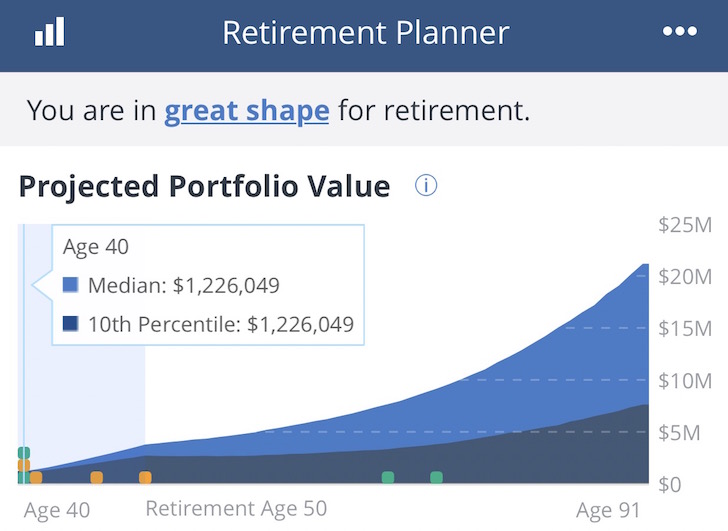
3) Realize your mortality by calculating how much you’ll have left at age 100. Acknowledge your mortality and calculate how much you’ll have left at age 100. Just as most Americans don’t properly calculate their retirement target and plan for how to get there, many of us don’t calculate how much we’ll end up dying with if we don’t spend more. Right now you will be taxed at 40%+ on any wealth you leave behind after $5.49 million. Divide your current net worth by the difference between 100 and your age. If the number is greater than your average annual spending, you should be able to spend more freely.

At least every six months, I run my finances through Personal Capital’s Retirement Planner on my iPhone, and every time it says I’m in “Great Shape.” Love it! I imagine it’s kinda like being a beautiful person looking at him/herself in the mirror each morning. You know you’re beautiful and can’t get enough of yourself!

Personal Capital Retirement Planner

$1.2M turns into $20M+ in 50 years? Time to spend!

4) Find your forever home. Once you’ve purchased a home you see yourself living in for 10+ years, you’ll feel a tremendous amount of relief. Saving up for a home is the largest financial undertaking for most people, especially those who live in major cities. Therefore, once you’ve conquered the tallest mountain, everything else will feel like an ant hill. Food and clothing are cheap in comparison.

Buying a primary residence is like paying yourself first. You’ll build equity through forced savings and hopefully principal appreciation over time. If you’re renting, you’ll always wonder when your rent will go up or when the landlord will want to kick you out for whatever reason. As a result, you’ll have a tendency to hoard your money to pay for moving expenses, and potentially a more expense apartment since rents tend to always go up.

After finding and remodeling an affordable home in San Francisco with panoramic ocean views, I finally felt I could spend whatever excess cash flow I had on nicer things. Each stage of the remodeling process had me shelling out an extra $30,000 – $60,000 over a 3-6 month period. Once all the remodeling was done, it felt like I had an extra $10,000 a month to spend on whatever I wanted. 

5) Set and achieve ambitious targets. The reason why the 1/10th rule for car buying is so powerful is because it forces people to tether their wants to achievement. Many people get mad when they want to buy a $40,000 car, but realize their $80,000 income means they should only purchase a ~$8,000 car. By flipping the equation and setting a goal to earn $400,000 a year, it motivates the buyer to work towards their desires. With all the extra hustle, it will allow the buyer to think twice about spending so much on something s/he really doesn’t need. And if the $400,000 income is achieved, then there will be no guilt spending so little.

Just like how you’ll feel so much better eating a cheeseburger after you’ve trained six months for a marathon, you’ll feel so much better spending money after taking years saving up for a certain stretch goal. The guy who got up to eat a cheeseburger after watching four hours of football isn’t going to feel as good as the marathon runner!

When I started suffering from tennis elbow at the age of 33, I made it a goal to go undefeated in one season at the 4.5 level. It was my way of giving the middle finger to pain. When I went 12-0 with various doubles partners in 2012, I felt an enormous amount of pride. It was easy to replace my ratty tennis bag with holes with a snazzy looking one. Three years later when I got bumped up to 5.0 (top 1%), my tennis budget blew wide open because players aren’t supposed to improve after the age of 35. 

In early 2015, I made an ambitious goal of growing organic traffic (not paid) to one million pageviews a month. After consistently hitting over 1 million organic pageviews a month for six months in 2017, I felt zero guilt paying $15,800 for a hot tub and $58,000 for a used Range Rover because it took me eight years of writing three posts a week. To understand how difficult that is, try writing one 1,500 word post a month. Now multiply that effort by 10. 

Enjoy Your Money

Most of us are afraid of being judged by others for how we spend our money. But the reality is, everybody’s financial situation is different. Paying $10,000 for a first class ticket is ridiculous for someone making less than $100,000 a year. But if you’re worth $100 million, $10,000 is like a dollar bus fare for the rest of us.

You can overcome your frugality disease by starting small, and working your way up. The easiest way to reduce your frugal habits is by making more money and achieving certain stretch goals. It’s when you buy things with money you don’t deserve (trust fund, inheritance, lottery, using a credit card, your spouse’s income, etc) that your conscience may start making you feel terrible about your spending.

You don’t get a gold star for being frugal. Being overly frugal simply means you haven’t earned or planned enough. You only get a gold star if you’re able to maximize your lifestyle with the money you’ve earned and not die with too much. Don’t let frugality be a crutch or an excuse for not making more.

I regret not spending more in my 20s and 30s. In my 40s and beyond, I’m determined to let the lifestyle I enjoy keep up with inflation and then some. For those who have their finances together, I hope you do the same!

Related:

When Income Is More Important Than Net Worth

It’s Impossible To Stay Retired Once You Retire Early

When Is It OK To Forsake Stealth Wealth?

Readers, anybody suffering from being overly frugal? What are some of the steps you are taking to be a better spender to optimize your lifestyle? Is being frugal a symptom of poverty? Share some of your tips on how to be more carefree.


from Financial Samurai https://www.financialsamurai.com/stop-frugality-from-leading-to-lifestyle-deflation/